

GraphqlOperation
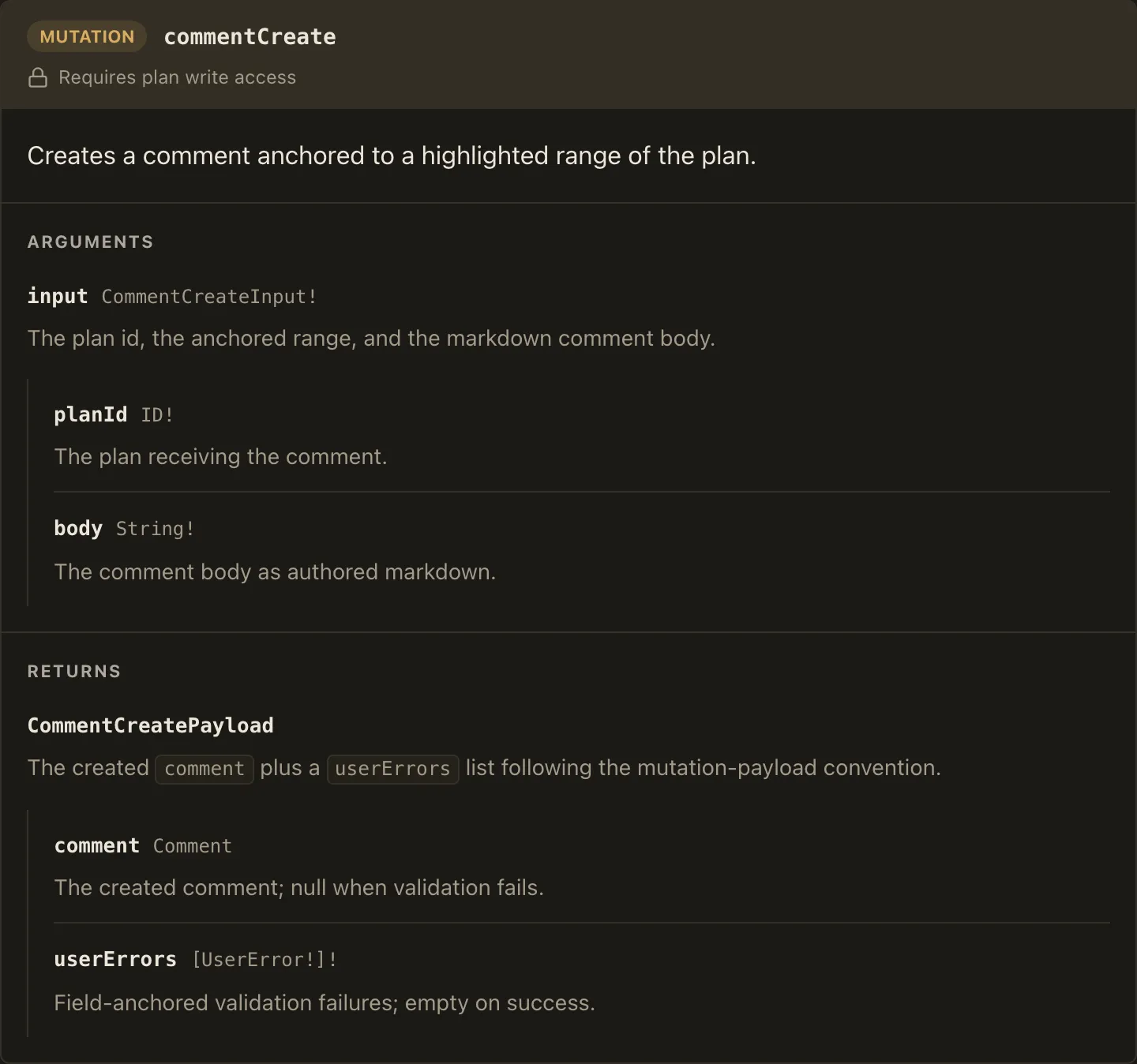
GraphqlOperation shows one proposed GraphQL capability - a query, mutation, or subscription - so a plan that introduces or changes a schema can be reviewed on the contract: what the operation takes, what it returns, and what running it actually looks like.
How it looks
Section titled “How it looks”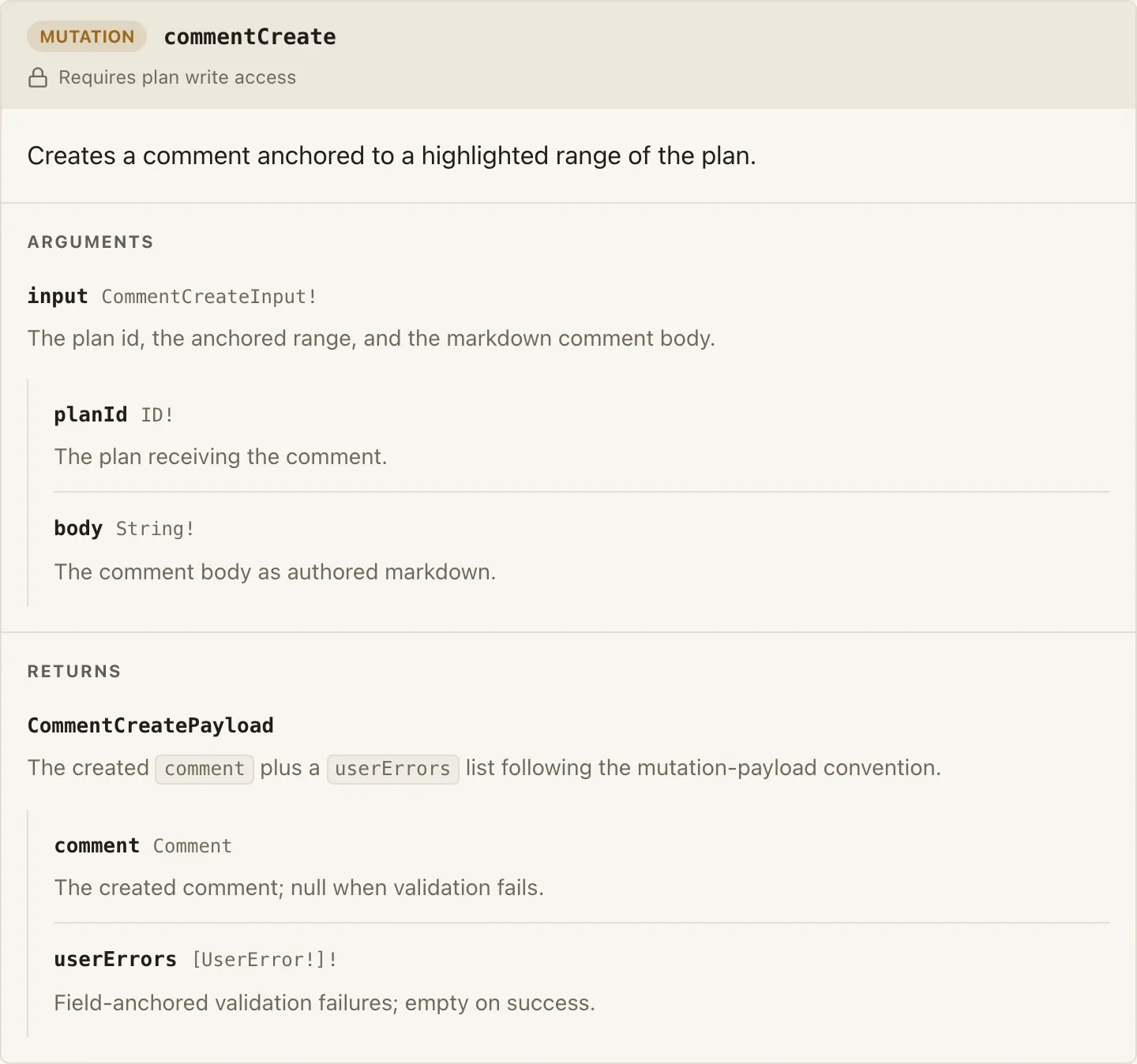
When to use it
Section titled “When to use it”Use GraphqlOperation when a plan proposes or changes a query, mutation, or subscription and the reviewer should judge its arguments, return shape, and an executable example with variables and response.
When not to use it
Section titled “When not to use it”- Loose GraphQL samples with no schema contract to review - use a plain
graphqlfence - Whole-schema SDL dumps - reference sites do not show SDL per entry, and neither does this card; describe type definitions in prose or a fence
Use cases
Section titled “Use cases”- Propose a new mutation with its input, payload convention, and an executable example operation
- Enumerate a planned schema surface compactly, since a header-only operation with just kind and name is valid
<GraphqlOperation kind="mutation" name="commentCreate" access="Requires plan write access">
Creates a comment anchored to a highlighted range of the plan.
<Argument name="input" type="CommentCreateInput!">
The plan id, the anchored range, and the markdown comment body.
</Argument>
<Field in="input" name="planId" type="ID!">
The plan receiving the comment.
</Field>
<Field in="input" name="body" type="String!">
The comment body as authored markdown.
</Field>
<Returns type="CommentCreatePayload">
The created `comment` plus a `userErrors` list following the mutation-payload convention.
</Returns>
<Field in="payload" name="comment" type="Comment">
The created comment; null when validation fails.
</Field>
<Field in="payload" name="userErrors" type="[UserError!]!">
Field-anchored validation failures; empty on success.
</Field>
<Operation>
```graphqlmutation commentCreate($input: CommentCreateInput!) {  commentCreate(input: $input) {    comment {      id    }    userErrors {      field      message    }  }}```
</Operation>
<Variables>
```json{ "input": { "planId": "pln_42", "body": "Keep the retry budget explicit." } }```
</Variables>
<Response label="Success">
```json{ "data": { "commentCreate": { "comment": { "id": "cmt_8f3a" }, "userErrors": [] } } }```
</Response>
<Response label="Validation error">
```json{  "data": {    "commentCreate": {      "comment": null,      "userErrors": [{ "field": ["input", "body"], "message": "Body is required." }]    }  }}```
</Response>
</GraphqlOperation>
Authoring
Section titled “Authoring”Attributes
Section titled “Attributes”| Attribute | Type | Required | Behavior |
|---|---|---|---|
kind |
enum: query mutation subscription |
Yes | The spec’s operation type; renders the kind badge beside the name. |
name |
string (non-empty) | Yes | The operation name, rendered monospace. |
access |
string | No | Access requirement (scopes, permissions), rendered as a lock-annotated line. |
deprecated |
bare boolean | No | Renders a Deprecated badge and strikes the name. |
deprecationReason |
string | No | The @deprecated reason, shown with the badge; invalid without deprecated. |
The markdown body before the scoped children is the operation’s description.
Argument
Section titled “Argument”Each Argument documents one argument: a required non-empty name and a required non-empty type rendered literally - GraphQL’s ! and [...] markers convey requiredness, so there is no separate required flag - plus a markdown body description.
Duplicate argument names are rejected.
Each Field expands one level of the input or payload shape: a required in (input or payload) that seats it under Arguments or Returns, a required name and literal type (GraphQL’s ! and [...] markers convey requiredness), an optional default, and a markdown body.
Duplicate in-plus-name identities are rejected; deeper nesting belongs to prose, not the card.
Returns
Section titled “Returns”At most one Returns names the required non-empty return type and carries a markdown walkthrough of the payload fields.
Operation, Variables, and Response
Section titled “Operation, Variables, and Response”Operation and Variables appear at most once; Response repeats with an optional label so a success example can sit beside the validation error that teaches how userErrors behaves.
Each takes exactly one fence of its required language - an executable graphql operation, json variables, and json responses - and all render together under one labeled Example section.
Variables without an Operation beside it is rejected, and every fence flows through the standard highlighting pipeline.
Component-specific violations report positional diagnostics, including a wrong-language or missing fence, duplicate arguments, repeated single-instance children, a deprecationReason without deprecated, and headings, footnotes, or nested components inside scoped-child bodies.
Argument, Field, Returns, Operation, Variables, and Response outside a declaring GraphqlOperation stay unknown components.