

QuickDecision
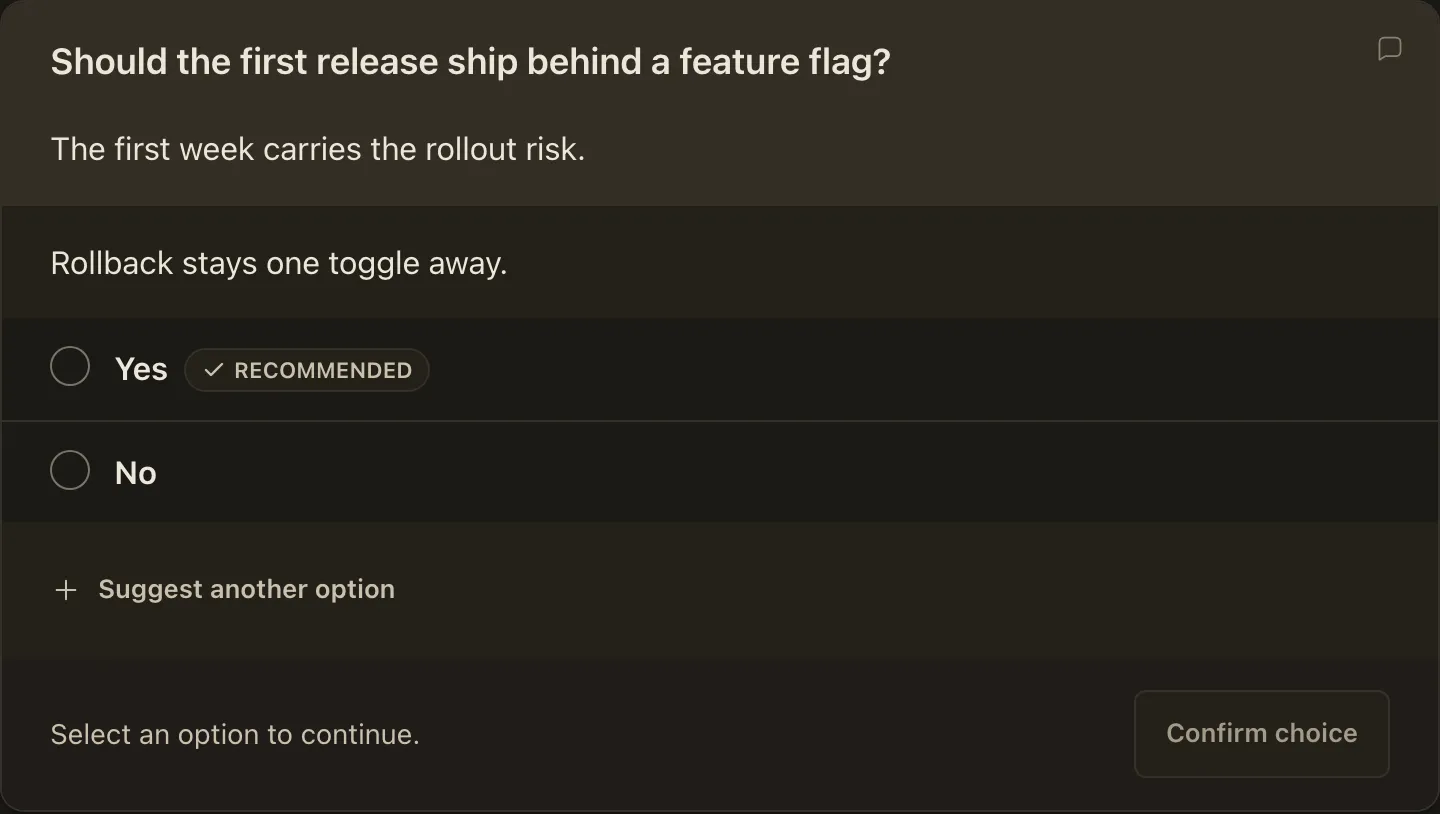
Each QuickDecision is a standalone brief: recommendation framing, radio options,
Suggest another option, and Confirm choice. It deliberately has no compare expander.
How it looks
Section titled “How it looks”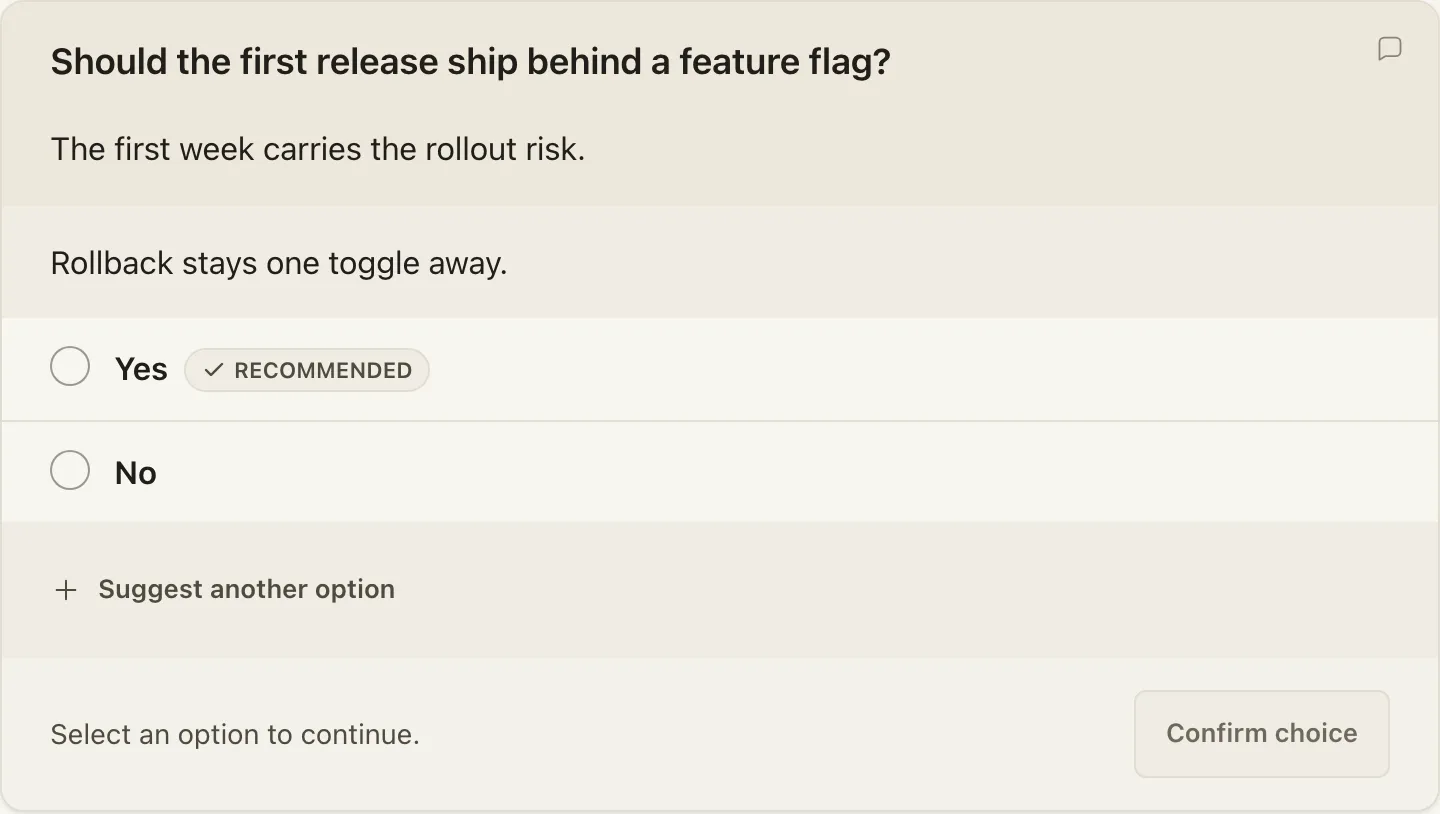
When to use it
Section titled “When to use it”Use it for one small, independently answerable question — one the reviewer can settle from the option titles alone. Render several in sequence when a plan has a batch of them; that is what the component is shaped for.
Mark it critical when the reviewer must settle the question before work begins.
When not to use it
Section titled “When not to use it”Do not use it when the reviewer needs to compare the options to answer, and do not use it to smuggle a weighty architectural choice past a matrix it deserves.
Compared with
Section titled “Compared with”Decision— reach for it when the reviewer needs each option’s considerations side by side.DecisionAnalysis— reach for it when the choice is weighty enough that the reviewer should audit it across criteria.
<QuickDecision question="Ship behind a feature flag?" context="The first week carries the rollout risk."> <Option title="Yes" recommended summary="Rollback stays one toggle away." /> <Option title="No" /></QuickDecision>Authoring
Section titled “Authoring”Attributes
Section titled “Attributes”| Attribute | Type | Required | Behavior |
|---|---|---|---|
question |
string | Yes | The question the card asks. |
context |
string | No | One orienting line above the options. |
state |
"proposed" | "decided" |
No | Defaults to proposed. |
critical |
bare boolean | No | Marks the question as one the reviewer must settle before work begins. |
Children
Section titled “Children”Option is valid directly in QuickDecision, and is self-closing.
| Attribute | Required | Behavior |
|---|---|---|
title |
Yes | The option’s name. |
summary |
No | One line of consequence. |
recommended |
No | At most one option may carry it. |
chosen |
No | Requires state="decided" on the parent. |
Add at least two uniquely titled options.
Answering it
Section titled “Answering it”A QuickDecision is proposed until it is settled, so write no state for a question you are
asking. A decided question renders as the record of what was chosen and stops asking.
Big Plan writes state="decided" and chosen into the plan source itself when the reviewer
answers at approval; author that pair by hand only for a choice settled before the review began.
Answer the plan’s decisions owns the recorded-answer behaviour.