

GrpcMethod
GrpcMethod shows one proposed RPC on a service, headed by the literal proto signature - rpc WatchComments(WatchCommentsRequest) returns (stream Comment) - so a plan that introduces or changes a gRPC surface is reviewed on what the .proto would actually say.
How it looks
Section titled “How it looks”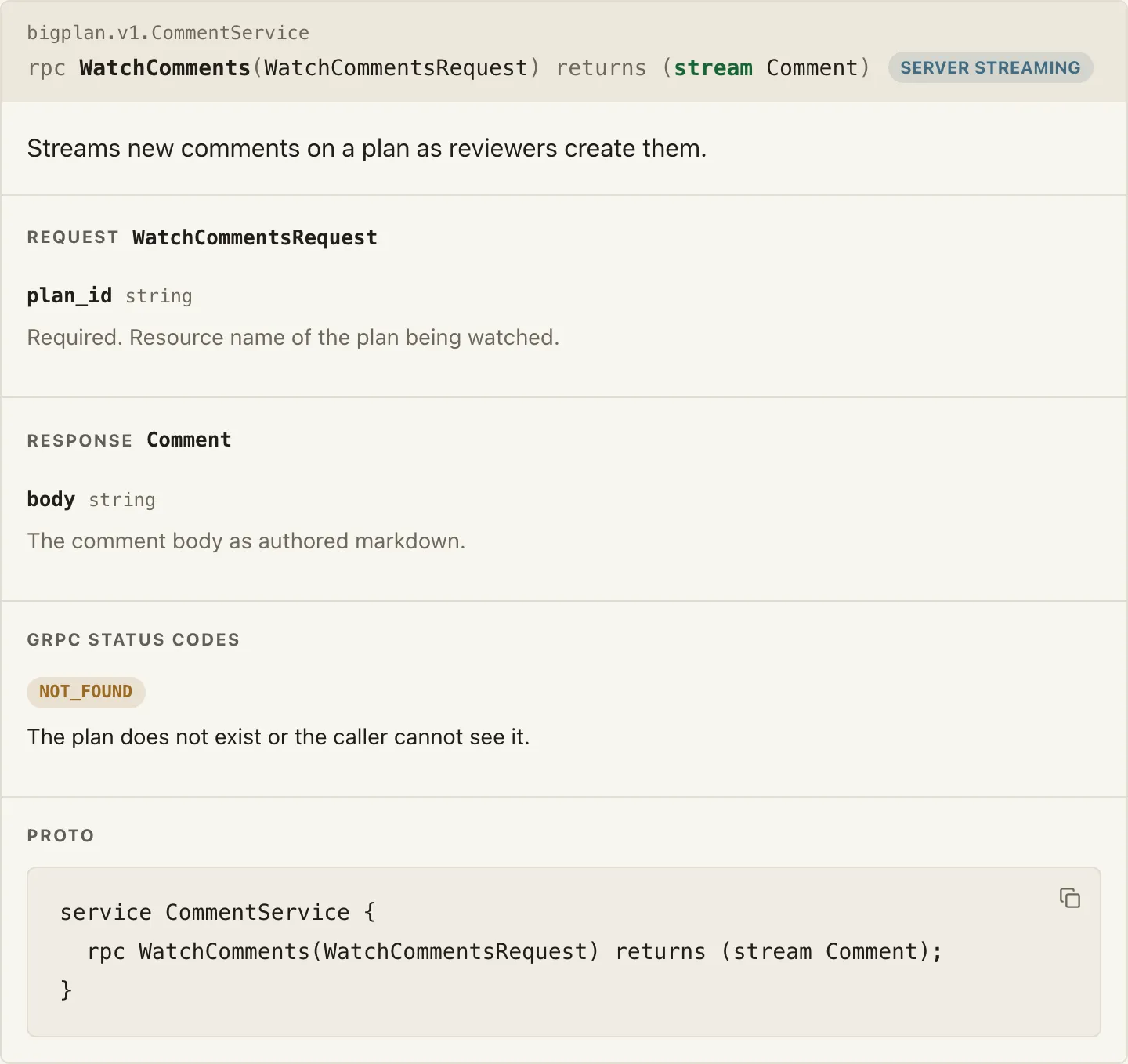
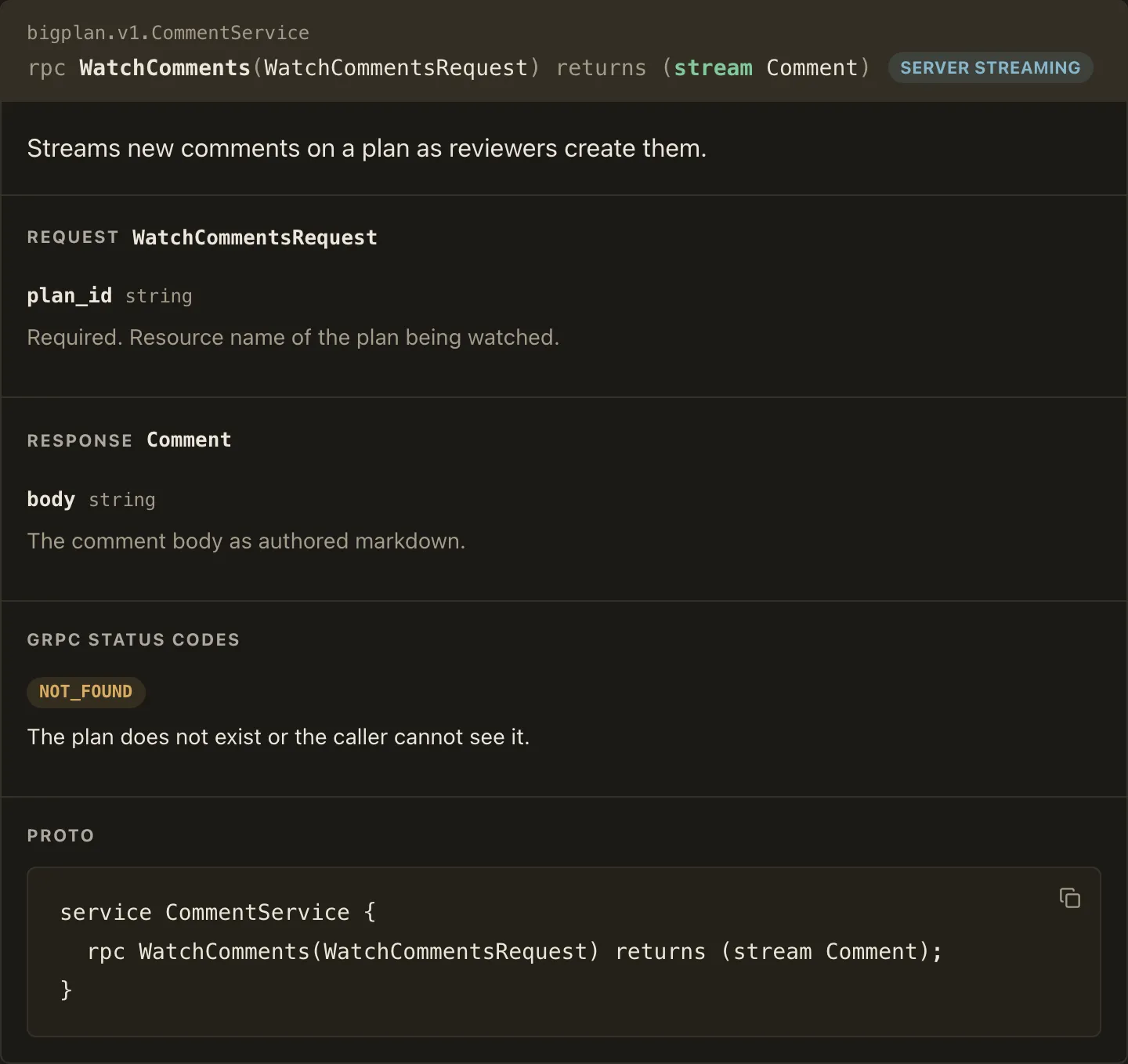
When to use it
Section titled “When to use it”Use GrpcMethod when a plan proposes or changes an RPC and the reviewer should judge the signature, the streaming kind, the request and response fields, and the failure codes.
When not to use it
Section titled “When not to use it”- Loose proto samples with no method contract to review - use a plain fence
- Whole-service or message-heavy schema dumps - the card documents one method; larger proto excerpts belong in prose or fences
Use cases
Section titled “Use cases”- Propose a streaming RPC where the streaming kind must be unmissable - the signature places the
streamkeyword and the badge names the kind, which even Google’s reference fails to surface - Document the canonical
google.rpc.Codefailures reviewers usually have to ask about
<GrpcMethod service="bigplan.v1.CommentService" name="WatchComments" request="WatchCommentsRequest" response="Comment" kind="serverStreaming">
Streams new comments on a plan as reviewers create them.
<Field in="request" name="plan_id" type="string">
Required. Resource name of the plan being watched.
</Field>
<Field in="response" name="body" type="string">
The comment body as authored markdown.
</Field>
<Error code="NOT_FOUND">
The plan does not exist or the caller cannot see it.
</Error>
<Example label="Request">
```json{ "plan_id": "plans/pln_42" }```
</Example>
<Example label="Stream">
```textcomment: cmt_8f3acomment: cmt_901b```
</Example>
<Proto>
```protoservice CommentService {  rpc WatchComments(WatchCommentsRequest) returns (stream Comment);}```
</Proto>
</GrpcMethod>
Authoring
Section titled “Authoring”Attributes
Section titled “Attributes”| Attribute | Type | Required | Behavior |
|---|---|---|---|
service |
string (non-empty) | Yes | Fully qualified service name, rendered as the card’s caption. |
name |
string (non-empty) | Yes | The method name inside the signature. |
request |
string (non-empty) | Yes | Request message type inside the signature. |
response |
string (non-empty) | Yes | Response message type inside the signature. |
kind |
enum: unary serverStreaming clientStreaming bidiStreaming |
No (default unary) |
Places the tinted stream keywords and renders the streaming badge. |
deprecated |
bare boolean | No | Renders a Deprecated badge and strikes the method name. |
The markdown body before the scoped children is the method’s description. A method with no description or scoped children renders as a compact header-only service entry.
Each Field documents one message field: a required in (request or response) that groups it into the matching section - each section names its message type beside the label, keeping the signature’s RPC-to-message model alive - a required non-empty name, an optional type, and a markdown body.
Proto3 has no required label, so requiredness stays prose in the description (“Required. …”), matching the ecosystem.
Duplicate in-plus-name identities are rejected.
Each Error documents one transport-level failure under the gRPC status codes section: a required code from the canonical google.rpc.Code error names except OK (NOT_FOUND, PERMISSION_DENIED, RESOURCE_EXHAUSTED, and the rest) and a markdown body explaining when it happens.
Duplicate codes are rejected.
Example
Section titled “Example”Example repeats with an optional label and exactly one fenced code block with a declared language, rendered together under one labeled Example section - typically a json request payload beside a text stream trace, since a stream’s behavior over time is what streaming-unfamiliar reviewers need to see.
At most one Proto carries exactly one proto fence - the raw-source secondary affordance behind the structured card.
Author the surrounding service block rather than repeating the header’s signature line, so the fence adds context instead of duplication.
Component-specific violations report positional diagnostics, including an unknown error code, duplicate field or error identities, a second Proto or a wrong-language fence, and headings, footnotes, or nested components inside scoped-child bodies.
Field, Error, Example, and Proto outside a declaring GrpcMethod stay unknown components.